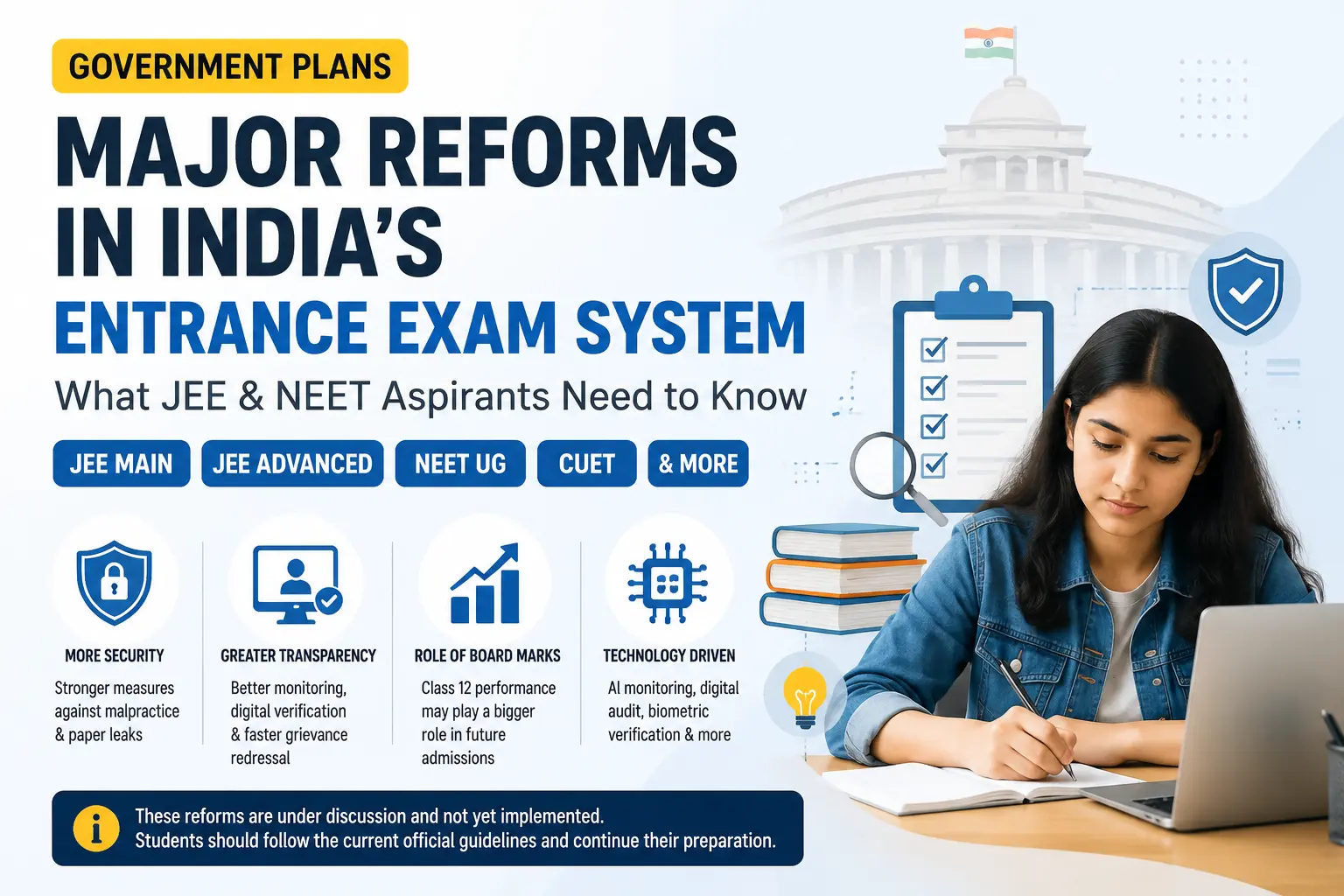
Government Plans Major Reforms in India’s Entrance Exam System: What JEE & NEET Aspirants Need to Know
India’s entrance examination system is undergoing significant review as the government explores measures to improve transparency, fairness, and the overall examination process. Following recent discussions on exam security and evaluation, several proposals are being considered that could shape the future of major entrance examinations such as JEE Main, JEE Advanced, NEET UG, CUET, and other national-level exams.
While many of these reforms are still under discussion and have not yet been officially implemented, students should stay informed, as future admission policies may evolve over the coming years.
Why Are Entrance Exam Reforms Being Discussed?
Recent concerns over examination security, paper leaks, and the need for a more transparent evaluation system have prompted the government to review the existing entrance examination framework. As part of this effort, a high-level task force has been announced to recommend technology-driven and structural improvements to strengthen the credibility of public examinations.
The objective is to create an examination system that is:
- More transparent
- Secure against malpractice
- Fair for students across different education boards
- Technology-enabled
- Reliable for higher education admissions
Proposed Changes Under Discussion
Although no final policy has been announced regarding admissions through JEE or NEET, several proposals have been widely discussed.
1. Increased Role of Class 12 Board Marks
One proposal being examined is to give greater importance to Class 12 board examination performance during the admission process, alongside entrance examination scores.
The proposal suggests that board examination performance could play a larger role in assessing a student’s overall academic ability rather than relying solely on a single entrance examination. However, no nationwide policy has been officially adopted.
2. Improved Examination Transparency
Authorities are exploring measures to increase transparency throughout the examination process, including:
- Stronger security protocols
- Better monitoring of examination centres
- Enhanced digital verification systems
- Faster grievance redressal mechanisms
- Secure evaluation and result processing
These initiatives aim to strengthen student confidence in national-level entrance examinations.
3. Greater Use of Technology
Technology is expected to play a central role in future examination reforms.
Some of the ideas being considered include:
- Expansion of computer-based testing where appropriate
- AI-assisted monitoring
- Digital audit trails
- Secure encrypted question paper distribution
- Biometric verification of candidates
The government has indicated that technology will be a key component of future examination reforms.
4. Stronger Measures Against Paper Leaks
Another major focus is preventing examination malpractice.
Recent proposals include:
- Tougher penalties for organized paper leak networks
- Faster investigations
- Dedicated task forces
- Speedier legal proceedings for exam-related offences
These measures are intended to protect the integrity of public examinations and restore confidence among students.
What Could These Reforms Mean for Students?
If implemented in the future, these reforms could have several implications:
- Greater emphasis on consistent academic performance in school.
- Increased importance of Class 12 board preparation.
- More secure and transparent entrance examinations.
- Reduced chances of exam malpractice affecting genuine candidates.
- Greater use of digital technologies in the admission process.
Students preparing for JEE, NEET, CUET, and other competitive examinations should continue focusing on both strong board examination results and entrance exam preparation until any official policy changes are announced.
Current Admission Process Remains Unchanged
At present, admissions to major engineering and medical institutions continue to follow the existing eligibility criteria and entrance examination procedures.
Students should rely only on notifications issued by the respective examination authorities for confirmed updates regarding eligibility, admissions, counselling, or evaluation methods.
Key Takeaway
India’s entrance examination system is expected to evolve with a stronger emphasis on transparency, technology, and fairness. Discussions around the role of board marks and improvements in examination security highlight the government’s intent to modernize the admission process. However, students should note that many of these ideas are still proposals and should continue preparing according to the current official examination pattern until any formal changes are announced.