


The JEE Main 2026 Session 2 began on 4 April 2026 with Shift 1 conducted from 9:00 AM to 12:00 PM. Lakhs of students appeared for this shift, hoping to secure good ranks for admission into NITs, IIITs, GFTIs, and qualification for JEE Advanced.
This detailed 1700+ word analysis covers the real difficulty level, subject-wise breakdown, topic-wise weightage, student reactions, and expected rank vs marks based on memory-based questions and expert feedback.
Overall Difficulty Level of JEE Main 4 April 2026 Shift 1
The paper was rated Moderate by most students and experts.
- It was balanced but slightly on the lengthier side, especially in Mathematics.
- Compared to previous shifts in April 2026, this paper was neither too easy nor extremely tough.
- Good attempts: 55–65 questions with high accuracy can fetch a decent percentile (98+).
Chemistry was the most scoring section, while Mathematics demanded more time due to lengthy calculations.
Subject-Wise Analysis
1. Physics (Moderate)
Physics was easy to moderate. Most questions were concept-based and formula-driven rather than heavily calculative.
Key Topics Asked:
- Mechanics (Laws of Motion, Work-Energy, Rotational Motion)
- Electrostatics & Current Electricity
- Modern Physics (Semiconductors, Photoelectric Effect)
- Optics and Waves
- Thermodynamics & Heat Transfer
Student Feedback: Many students found Physics manageable. Direct NCERT-based questions helped those who revised formulas thoroughly. A few numericals from Gravitation and Fluid Mechanics were tricky but solvable with good conceptual clarity.
Good Attempts: 18–22 questions
2. Chemistry (Easy to Moderate – Most Scoring)
Chemistry was the easiest section for most candidates.
Key Topics Asked:
- Organic Chemistry (GOC, Hydrocarbons, Biomolecules, Polymers)
- Inorganic Chemistry (Coordination Compounds, p-block, d-block)
- Physical Chemistry (Chemical Kinetics, Equilibrium, Solutions, Thermodynamics)
- Some direct questions from NCERT examples and previous year repeats.
Student Feedback: Students who had revised NCERT thoroughly found this section very scoring. Organic and Inorganic portions were straightforward. Physical Chemistry had a few calculation-based questions, but they were not too lengthy.
Good Attempts: 22–25 questions (highest scoring section)
3. Mathematics (Moderate to Difficult – Lengthiest)
Mathematics was the toughest and most time-consuming section for many students.
Key Topics Asked:
- Calculus (Definite Integrals, Differential Equations, Continuity & Differentiability)
- Coordinate Geometry (Straight Lines, Circles, Parabola)
- Vectors & 3D Geometry
- Matrices & Determinants
- Probability & Statistics
- Sequences & Series
Student Feedback: Questions were concept-heavy and required lengthy calculations in several cases. Many students reported that they could not attempt all questions due to time constraints. Algebra and Calculus dominated the paper.
Good Attempts: 12–18 questions (with high accuracy)
Overall Paper Analysis Summary (4 April 2026 Shift 1)
- Overall Difficulty: Moderate
- Easiest Section: Chemistry
- Toughest Section: Mathematics (due to length)
- Balanced Paper: Yes, with fair distribution across syllabus
- Time Management: Crucial — students who managed time well in Maths performed better
- NCERT Weightage: High (especially in Chemistry and parts of Physics)
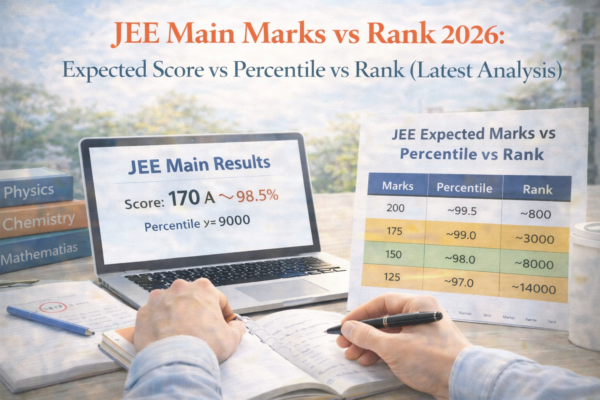
Expected Rank vs Marks for This Shift (Based on Trends)
| Marks (Out of 300) | Expected Percentile | Expected CRL Rank Range |
|---|---|---|
| 260+ | 99.90+ | Top 500 |
| 240–259 | 99.70–99.90 | 500 – 2,000 |
| 220–239 | 99.40–99.70 | 2,000 – 6,000 |
| 200–219 | 98.80–99.40 | 6,000 – 12,000 |
| 180–199 | 97.50–98.80 | 12,000 – 25,000 |
| 160–179 | 95.50–97.50 | 25,000 – 45,000 |
| 140–159 | 92.00–95.50 | 45,000 – 80,000 |
Note: These are approximate ranges. Final percentile depends on normalisation across all shifts.
Student Reactions (Live Feedback)
- Many students said Chemistry saved their paper.
- Mathematics was called “lengthy but doable” by well-prepared students.
- Overall sentiment: “Paper was better than expected, but Maths took a lot of time.”
- Students who revised NCERT thoroughly felt confident.
Important Links
- Official JEE Main Website
- JEE Main 2026 Exam Dates
- JEE Main 2026 Syllabus
- JEE Main 2026 Exam Pattern
- JEE Main 2026 Result
Preparation Tips After This Shift
If you have upcoming shifts:
- Focus more on Mathematics speed — practice timed sectional tests.
- Revise high-weightage chapters from NCERT (especially Chemistry).
- Solve at least 2 full-length mock tests daily.
- Analyse mistakes from this shift’s memory-based questions.
Memory-Based Question Papers & Solutions are now available on platforms like Careers360, Collegedunia, Aakash, and eSaral (YouTube channels have detailed video solutions).
Would you like a subject-wise memory-based questions list from 4 April 2026 Shift 1? Or a detailed topic-wise weightage breakdown?
Share your expected score or how your attempt went in the comments — I can help you estimate your percentile and suggest safe colleges.